Methodology
AI Development Workflow
A unique development process that combines Spec-Driven Development with a coordinated team of specialized AI agents.
01 — Spec-Driven Development (SDD)
Every project begins with a comprehensive specification document that defines architecture, data models, API endpoints, user flows, and constraints. This document is the single source of truth for the entire development lifecycle.
The SDD approach eliminates ambiguity, reduces rework, and ensures that every agent — and every output — is aligned with the client's real requirements from day one.
02 — Pipeline Overview: The Cybernetic Scrum Team
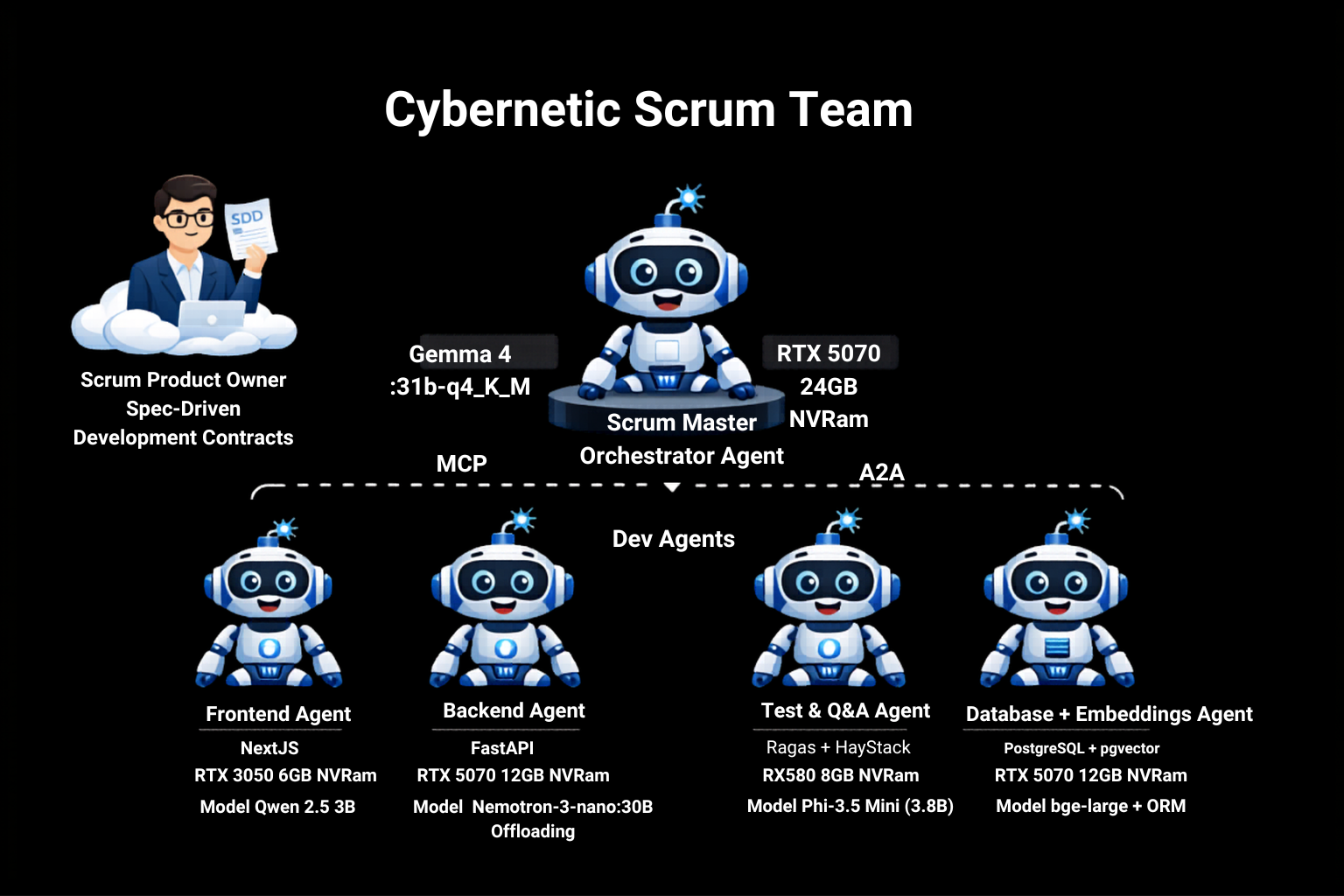
The core of this workflow is a fully local, multi-agent system organized around the Scrum methodology — but executed entirely by specialized AI agents. Each agent runs a purpose-fit language model on dedicated GPU hardware, communicating through two open protocols: MCP (Model Context Protocol) for tool and resource access, and A2A (Agent-to-Agent) for direct peer coordination. No cloud. No vendor lock-in. No data leaving the infrastructure.
Technologies Inside the Team
The central brain. Receives the SDD contract from the Product Owner, breaks it into tasks, assigns work to specialist agents, resolves conflicts, and validates the final delivery. Runs a 31-billion-parameter model quantized to Q4 — enough reasoning depth to hold the full project context.
Generates Next.js components, pages, and client-side logic from the spec. A compact 3B model is sufficient for UI code generation tasks, keeping GPU cost low without sacrificing output quality.
Builds FastAPI services, business logic, and integrations. Uses a 30B model with CPU offloading to handle complex API design, schema validation, and async patterns that require deeper code understanding.
Validates every deliverable against the spec using Ragas (RAG evaluation framework) and HayStack pipelines. Runs on an older GPU because evaluation tasks are less compute-intensive — an intentional cost-efficiency decision.
Designs PostgreSQL schemas, writes migrations, and manages pgvector embeddings for semantic search and RAG. The bge-large embedding model produces high-quality vector representations without requiring a massive generative LLM.
MCP (Model Context Protocol) gives each agent structured access to tools, files, and external APIs through a standardized interface. A2A (Agent-to-Agent) enables the orchestrator to delegate tasks and receive results from specialist agents in a structured, auditable way.
Why This Is Hard to Replicate With a Human Team
Assembling a human team with equivalent coverage — a senior frontend engineer, a senior backend engineer, a DBA with ML/embeddings expertise, a QA automation engineer, and a technical Scrum Master — means recruiting five highly specialized professionals in a tight market. In the United States, fully-loaded compensation for this profile runs $12,000 to $20,000 USD/month per person, putting the monthly payroll between $60,000 and $100,000 USD before benefits, equity, or tooling. In Western Europe (UK, Germany, Netherlands), rates are €8,000 to €15,000/month per specialist, totalling €40,000–€75,000 for the same five roles. That assumes you can find and retain all five simultaneously — which, in practice, takes months of recruitment.
Beyond cost, human teams introduce structural friction: timezone gaps, knowledge silos, inconsistent code standards, PTO, and full onboarding for every new project. The Cybernetic Scrum Team eliminates all of that. It runs 24/7, applies the same quality standards to every task, holds the complete project context at all times, and scales instantly to new specs without ramp-up.
03 — Cybernetic Scrum Team
Orchestrator
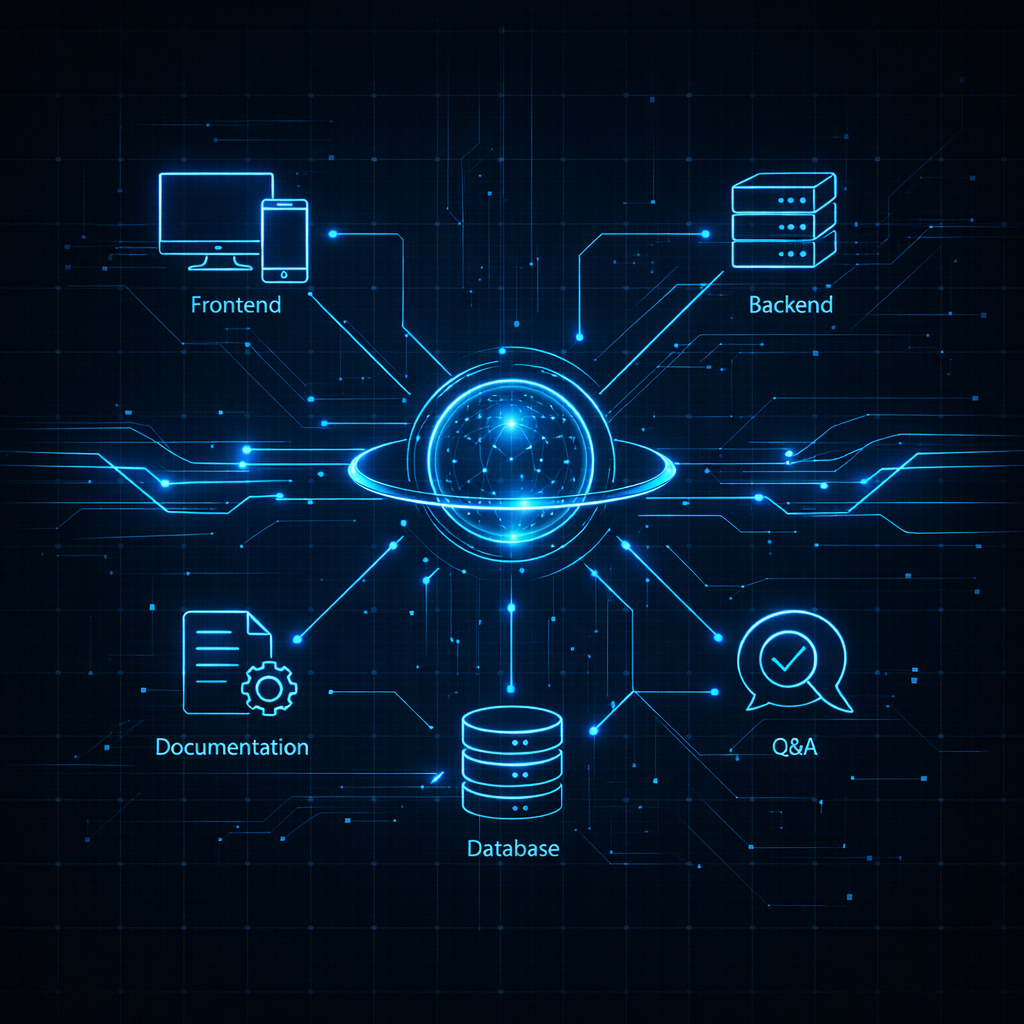
Receives the spec and distributes tasks to specialized agents. Manages priorities, resolves conflicts, and coordinates the full pipeline.
Frontend Agent
Generates UI components, pages, and client-side logic. Implements design specs with accuracy and consistency.
Backend Agent
Builds APIs, business logic, and service integrations. Ensures correctness against the spec's data models and endpoints.
Database Agent
Designs schemas, writes migrations, and optimizes queries for performance and data integrity.
Q&A Agent
Validates every output against the spec. Detects bugs, inconsistencies, and risks. Triggers refinement loops until standards are met.